

Magento Commerce

Easter: A Marriage of Cultures

When most Americans think about Easter, they think about the Great Easter Bunny, distributing toys, candy and gifts to the little ones, while others think of it as the Day that Christ was resurrected and eventually re-ascended to Heaven.
Yet the history and lore of Easter is far richer than either of these two paradigms. Easter reaches far back into pre-history and into our very hopes and dreams surrounding love, wealth, fertility and prosperity.

The name ‘Easter’ seems to originally be derived from the proper name of Oestre or Eastre which is the name of an ancient Saxon fertility Goddess, often thought of as ‘The Great Mother’. Modernly referred to as Ostara, she is a Goddess of beginnings, fertility and Spring ; thus her time was at the Dawning of the day. As the Saxon peoples spread out and diversified, their influence and customs affected groups as far west as the British Isles and as far east as the Magyars in Eastern Europe, well into the Dark Ages.

The ancient art of Pysanka in the Ukraine is an ancient Spring rite originally dedicated to a sun god called Dazhboh, in honor of the renewal of life and prosperity after a cold, hard winter. In pre-Christian times, the creation of pysanka was thought to directly correspond to the survival of the world. Literally, if not enough were made, a giant serpent would be unleashed and cause destruction and havoc over all the world.

A newer version blending in Christianity tells how the Virgin Mary gave eggs to the soldiers of the cross. She entreated them to be less cruel to her son and she wept. The tears of Mary fell upon the eggs, spotting them with dots of brilliant color. Still another tale, tells of Simon the peddler, who helped Jesus carry his cross on the way to Calvary. He had left his goods at the side of the road, and, when he returned, the eggs had all turned into intricately decorated pysanky.

Pysanky were thought to protect households from the evil eye, evil spirits, catastrophe, lightning and fires. Pysanky were believed to hold powerful magic and their misuse could cause sickness, famine and death.

Many Pysanky utilized designs we often think of as Celtic. The spiral was a favorite and often thought of as exceptionally powerful. Modern pysanky are often decorated with floral and animal designs along with Celtic knotwork. this shows the influence of Celtic design into Eastern European areas and even into Russia itself.

Most Pagan religions in the Mediterranean area had a major seasonal day of religious celebration at or following the Spring Equinox. Cybele, the Phrygian fertility goddess, had a consort, Attis, who was believed to have been born via a virgin birth. Attis was believed to have died and been resurrected each year during the period of the seasonal shift into Spring.

It is not surprising then that the early Christian church would select this time to celebrate perhaps their greatest tale of rebirth, renewal and resurrection. In the early church times, more conversion was accomplished with the application of honey than by the sword. It was relatively easy to convince otherwise pagan people to simply add in at first the tenets of this new religion and over time, eventually eschew the remnants of their formerly pagan lives.

While Easter is not a specifically Celtic or Irish tradition, it has been celebrated in these lands for quite some time. In pre-Christian times as part of the various Spring rites and traditions of the ancient Celts and more modernly with the heavy Christian influence which permeates the British Isles today.

At Easter celebrations all around the world, it is easy to see the remnants of older belief systems side by side with the newer Christian elements, creating a blending of cultures allowing the new and the old to exist relatively seamlessly or at least tolerably with each other.

The more recent controversy of those extremists holding more virulent, evangelical views is a dis-service in my opinion, to the otherwise rich history of Christianity and those cultures it has touched and influenced over the years. Christianity was not created in a vacuum, but was brought together by diverse groups of people who voluntarily (at least originally) chose to look at life through the teachings of Christ, under a single god, rather than a pantheon which required regular tribute.

The Meaning Of Celtic Knots – Part II

How do you understand the meaning of a knot? What attracts us to a particular motif is often mysterious, but you can perhaps gain some insight based on these interpretations.

Square Motifs:

Squares are not all that common in nature, be we as human beings do depend upon them. Look at where you see squares around you and you will understand how this blue print concerns structures and foundations. Also, squares are said to symbolize the five senses-four points and the center.

Triangular Motifs:

In nature, you find triangles in the features of birds, the tops of waves and the end of leaves. Humans use triangles to create arrows and to create pyramids. You can begin to see how a triangular pattern, or vectors, might suggest focused energy directed toward a specific point.

Spiral Motifs:

The spiral is an ancient motif that is found all over the world. Spirals are actually elements of spheres, which are three dimensional circles. Consider how events in your life may outwardly appear the same, but over time, your view changes. Spirals represent growth or evolution in your own circle walk, which is another way of saying, your life journey.

Trinity Motifs:

Trinity motifs are common in Celtic jewelry designs. Many religious traditions, of course, have their own profound understanding of what the trinity means. Basically, from the most universal perspective, the trinity represents Unity that is divided into two parts, male or female. The Celtic trinity symbolized the mother, maiden and crone; earth, heavens and the underworld; and the past present and future.

Celtic Crosses:

The image of the cross is ancient and predates Christianity. A basic and universal perspective of the cross is that it symbolizes the intersection of human and divine. The vertical axis of the cross represents the heavens, while the horizontal signifies the manifest world.

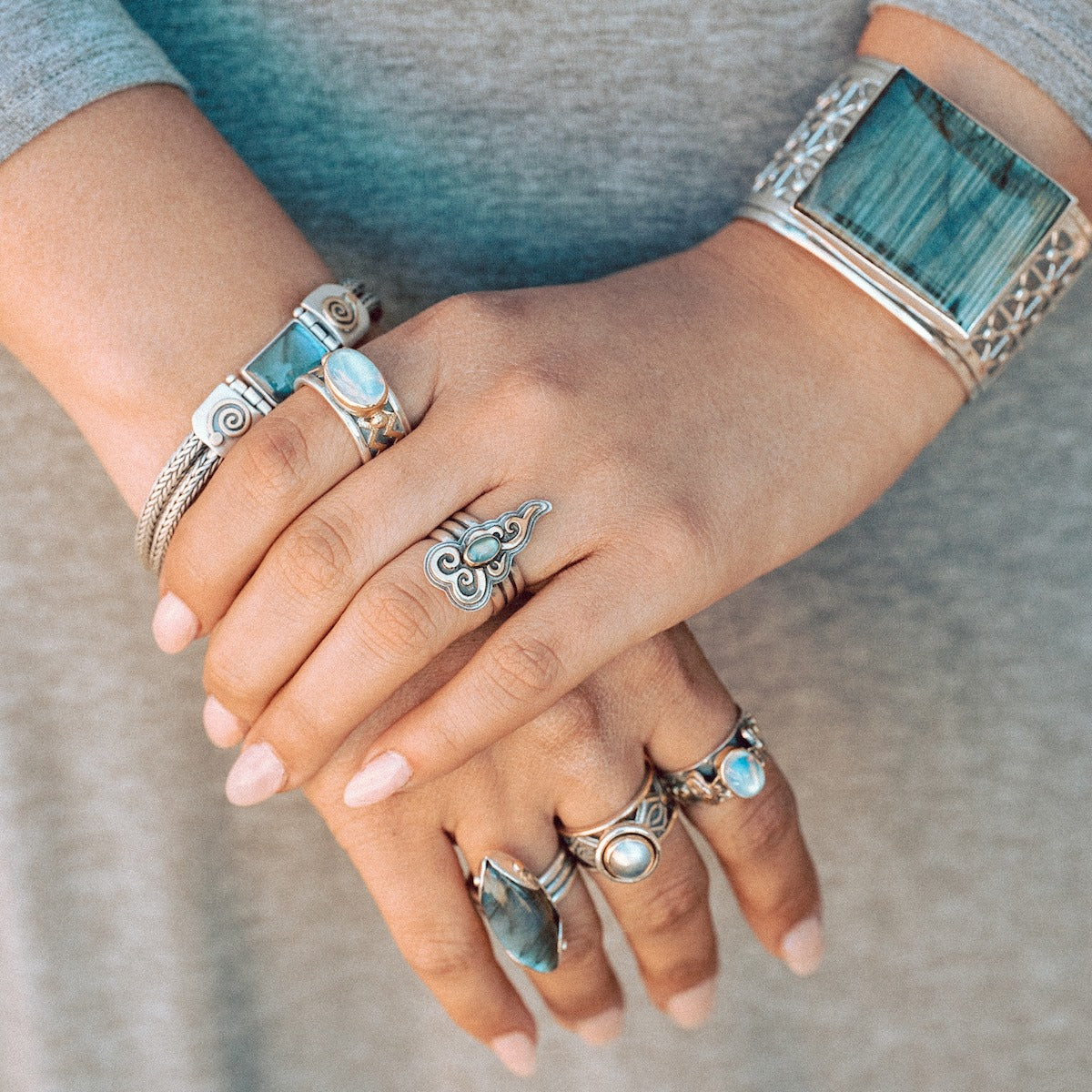
Look at one of the jewelry knot motifs. Imagine that you are riding on its track. How does it feel? Next, consider the shapes and begin to interpret the symbolic meaning based on some of the ideas mentioned above. Finally, consider what the knot motif might teach you about your life now.

The Meaning Of Celtic Knots – Part 1

You can understand the meaning of Celtic knots yourself. Circles, squares, triangles and crosses create the motifs found in Celtic jewelry. These patterns and shapes actually have certain functions in the physical world. In Celtic knots, shapes are combined. Crosses are made out of triangles and trinity motifs, for example. Yet a basic understanding of the meaning of basic shapes will enable to understand for yourself how to interpret meaning in your ring, pendent or any other piece of jewelry.

The Line:

It seems pretty obvious, that everything starts with an individual point of view, a line or vector that is a trajectory toward a certain destination. Lines are the basis of any Celtic design. In Celtic jewelry, a line can be straight, curved or irregular. It can have an ending, or it can connect with other lines and be endless, representing eternality. Lines in Celtic jewelry design are the elements from which knots are made.


(This piece shows the complexity of lines intersecting lines to create a beautiful design.)

Cross Motifs:

From the line, the most basic element of any piece of Celtic jewelry knot work is the crossing of two lines. Any time that two separate paths cross, you have the possibility of a new perspective. Look at the lines in a piece and decide in a general sense whether the pattern flows with harmony, or is it more jagged with points, suggesting a rich and potent discord?


(For example, in this ring, the simple crossing of the line suggests harmony and balance, the coming together of two perspectives.)

Circle Motifs:

The most basic knot is circular or has parts of circles. Consider, now, what a circle symbolizes. Look around you right now with your round eyes and see all that is in the form of the circle. We speak of a circle of friends and the cycle of the days and seasons. Certainly circle teaches about equality and community. Circles are cohesive wholes that allow life to exist as it is.


(This image of the circle is made up of spirals.)

Wave Motifs:

Parts of circles – the arcs – form wave like patterns. Waves are fundamental expressions of all that exists. Particle physics states that matter itself exists in waves. On a more basic level, remember what it is like to be in the ocean and feel the steady rhythm of waves. Waves represent steady, regular movement and flow over time.

Celtic Nature Motifs:

Not all designs from the Celts were knots. The movement and flow of water, or the curl of roots and vines, were common in Celtic motifs. Some of these designs seem particularly contemporary today, even though they are ancient.